
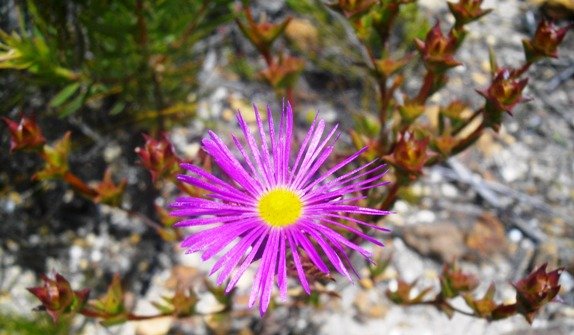
Erepsia anceps flower
Author: Ivan Lätti
Photographer: Thabo Maphisa
The flowers of Erepsia anceps grow solitary at branch tips. A flower consists of a whorl of narrow, spoon-shaped, pink or magenta petals around a yellow centre.
The flower centre comprises a dense cluster of staminodes (infertile stamens without anthers) around the real stamens and the female styles that become hidden from sight by the staminodes. The ovary top below, from whence the staminodes, stamens, styles and nectaries grow is concave, causing the staminodes to lean inwards. This creates work for particularly the beetle monkey pollinators that have to dig through the staminodes for reaching pollen and nectar. Once the food source is known, determination is provided by hunger, a universal motivator of the living, including a horde of insects.
Several Erepsia plants of the Western Cape, known as altydvygies (forever mesembs), keep their flowers open day and night, unlike the (also) many mesembs that close them at sunset. Remaining open permanently until a flower dies, Erepsia flowers can thus be pollinated by both day and night insects, the particular service arrangements varying from species to species.
The fruit is a woody capsule of about 6 mm in diameter, keeping the seeds safe until dispersal (Manning, 2007; Smith, et al, 1998; iNaturalist).