

Erepsia
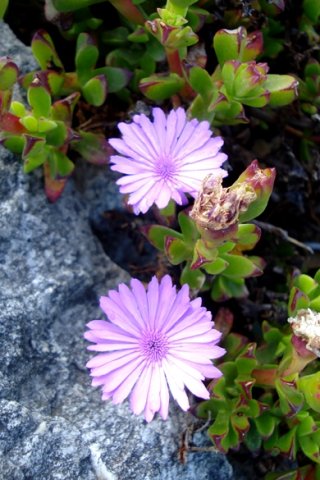
Author: Ivan Lätti
Photographer: Judd Kirkel Welwitch
Erepsia is a genus of perennial leaf succulents in the Aizoaceae or mesemb family. The smooth-stemmed shrubs and shrublets are erect or decumbent, often branching at the base.
The leaves are sharply three-angled or triangular in cross-section, ending in sharp to thorny tips with mucros, tiny hard or hair-like protrusions. Thin, waxy layers cover the smooth leaf surfaces, often with glassy dots. There are many Aizoaceae species bearing three-sided, angled leaves, such as some delospermas.
The inflorescences may be many-flowered or single-flowered, often short-stalked or nearly stalkless. There are five fleshy sepals. The mostly oblong petals grow in several spreading whorls. Petal colours are pink, purple or white.
The stamens arise from the calyx tube, the top of the ovary in the flower base. They are surrounded by staminodes, a multitude of sterile stamens consisting of filaments only. The generic name, Erepsia, is derived from the Greek word, erepsis, meaning "I hide myself". This refers to the real reproductive parts, stamens and styles, being hidden under the staminodes that bend in over them, as the ovary top is concave. Partly or fully covered varies among the Erepsia species. Such modesty is not unknown in the floral world. Staminodes may also resemble petals as in canna flowers.
Nectaries in erepsias are continuous rings or groups of small protrusions in the flower base. The usually five stigmas are small.
The flowers of many Erepsia and other Aizoaceae species remain open day and night. This earned them the Afrikaans name of altydvygies (always mesembs). Such flowers may be pollinated diurnally, nocturnally or both. The service arrangements varying among the species. Many other Aizoaceae species close daily at sunset, opening at some time in the morning.
Erepsia flowering happens in spring and summer.
The fruit is a woody, mostly five-locular capsule, in some cases more, up to thirteen. The capsule resembles those of the Lampranthus genus. The base of the capsule is funnel-shaped, the keels ending in awns. The covering membranes have closing ledges on the sides. The valve wings are variable. There are no closing bodies. The seeds are large, dark-brown and rough-surfaced.
There are at the time of writing about 31 Erepsia species, almost all in the Western Cape, otherwise the Eastern Cape. The plants are commonly known as spoonfigs.
The plant in picture is Erepsia inclaudens (Leistner, (Ed.), 2000; Vlok and Schutte-Vlok, 2015; Smith, et al, 1998; http://www.theplantlist.org).