

Leucadendron teretifolium
Author: Ivan Lätti
Photographer: Francelle van Zyl
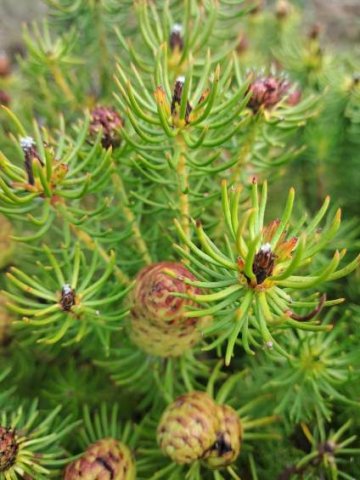
Leucadendron teretifolium, commonly known as the needle-leef conebush, in Afrikaans as the waterbossie (little water bush) and previously scientifically as L. abietinum, reaches heights from 30 cm to 1,3 m. The dense, dark green shrub is low-growing and single-stemmed, not resprouting after fire but spreading near the ground. The plants tend to grow in dense, isolated stands.
The cylindrical, needle-like leaves are non-tapering, ending in finely pointed tips. The leaves grow spiralling or scattered on the stems, curving up. The leaves are green, in picture yellow- or reddish-tipped. The leaves on female plants (the species being dioecious), are about 22 mm long, on male plants only about 8 mm. The specific name, teretifolium is derived from the Latin words teretis meaning cylindrical and folium meaning leaf, referring to the leaf-shape.
The involucral leaves are inconspicuous. The female cones are hairless, compact with green, notch-tipped involucral bracts tight on the surfaces, often reddish in their upper parts, more so towards the cone tips. Female cones are about 35 mm long, 24 mm wide with more or less pointed tips. Seeds are retained in the cones for many years, released through fire. This fire-adaptation in plant species is called serotiny.
Male cones are yellow with pollen when ripe, about 14 mm long and 7 mm wide. The florets have a yeasty aroma. The pollen is blown off the plant in showers, pollination happening by wind. Flowering happens late in winter and early in spring.
The species distribution is in the southwest of the Western Cape, from Ceres and the Witteberg to Worcester, Elim and along the Langeberg Mountains to Riversdale.
The habitat is sandstone and shale fynbos on mountain slopes, as well as in some renosterveld. The habitat population is deemed of least concern early in the twenty first century (Curtis-Scott, et al, 2020; Mustart, et al, 1997; Rebelo, 1995; Bond and Goldblatt, 1984; iNaturalist; Wikipedia; http://redlist.sanbi.org).