

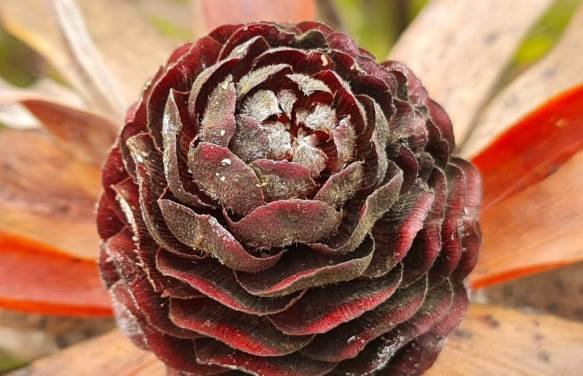
Leucadendron fruit cone, old and woody
Author: Ivan Lätti
Photographer: Uri Mitrani
This old, woody, female Leucadendron cone is dry and brown. Its curving bracts that formed a tight cone when they contained florets and later seeds, are now parted, evenly spaced, and opened for releasing their ripe seeds or has probably already done so. Bracts in the lower rows have wider, flat upper margins, the upper ones narrow to pointed. Otherwise the Euclid of cone dimensions wouldn't fit. The cone, hairy in parts on the outer surfaces of the bracts, does not appear to have burned before opening, its bracts having lifted from the chambers without being scorched.
Serotinous Leucadendron species retain their winged seeds in the cones on the female bushes until released by fire. This constitutes a natural, self-grown, canopy seed bank system, driven to dispersal by wind, after being triggered by fire. Fire kills the single-stemmed, nonsprouter Leucadendron species but not the seeds or mostly not. It reduces the multistemmed species to new sproutings when things have cooled down, best after rain.
Other Leucadendron species, probably about half of them, release their seeds annually spontaneously, or at various stages after ripening. So, no fire is needed for seed dispersal of the non-serotinous ones. They depend on ants or rodents rather than wind for this service. Some of these species have fruits, nutlets, continuously available on the (female) plants, a considerate gesture to their service providers by feeding them for longer, as mothers would.
The non-serotinous species include L. argenteum, L. salignum and L. lanigerum. As with many phenomena in nature, the categories are not always clearcut, discrete or uniform. Some species fill gaps in border areas, not only to draw out the deliberations for reaching conclusions by people that way inclined, but to strengthen nature’s biodiversity, covering all bases.
Serotinous species include L. xanthoconus, L. rubrum and L. salicifolium. Some of the serotinous species may begin to loosen their bracts after several years even without fire. This happens especially to very old cones, plants stressed by drought or summer heat, and when branches die.
This cone may have belonged to a non-serotinous Leucadendron species, but even that is not certain. The unknown sometimes invites risk by welcoming quests and questions (Leistner, (Ed.), 2000; Manning, 2007; Rebelo, 1995; iNaturalist; Wikipedia; https://www.proteaatlas.org.za).