

Grielum humifusum var. parviflorum
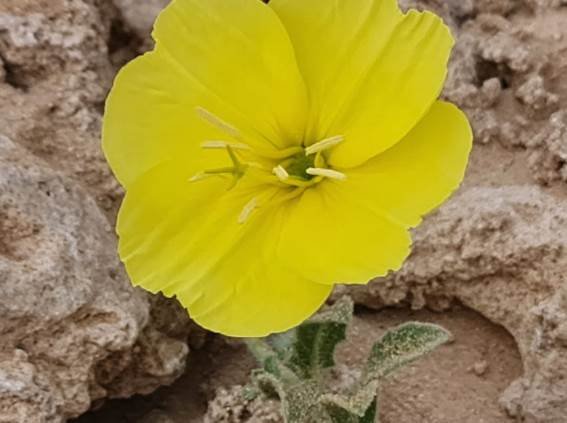
Author: Ivan Lätti
Photographer: Uri Mitrani
This plant is thought to be Grielum humifusum var. parviflorum, a lesser known and photographed variety of G. humifusum. It is a sprawling perennial commonly known as the small-flower paper snotblom (snot flower), rarely exceeding 30 cm in height.
The leaves are less serrated than those of the more common var. humifusum. Somewhat oblong to elliptic with pointed tips and whitish midrib seen from the back, the blade halves curve in laterally and the leaf as a whole sometimes curves its tip back.
As the variety name, parviflorum suggests, the flowers are smaller than those of its closest relative. Not less yellow, and there is no lighter coloured patch in the centre here, neither is there the usual five petals! The four, rounded petals are shallowly notched at their tips and the margins overlap each other clockwise. At least seven stamens can be discerned, their anthers narrowly oblong, two-lobed and much paler than the bright coloured petals.
The variety distribution is in the Western Cape and the Northern Cape, also in some neighbouring countries, the same as is said about the humifusum variety.
The habitat is then probably about the same, sandy places and disturbed spots in drier sandy soil parts. The population of this variety is deemed of least concern early in the twenty first century.
Pietsnot is a common name given to the species as a whole for edible, fleshy but mucilaginous or slimy taproots, resembling nasal mucus. They are eaten for moisture and nutrition by animals and people. Visiting city people may not get that hungry or thirsty, but curiosity and the interests of science sometimes win. Wash them first though (Van Rooyen and Van Rooyen, 2019; Manning and Goldblatt, 1997; iNaturalist; Wikipedia; https://www.botanicalrealm.com; http://redlist.sanbi.org).