

Erepsia bracteata flower
Author: Ivan Lätti
Photographer: Uri Mitrani
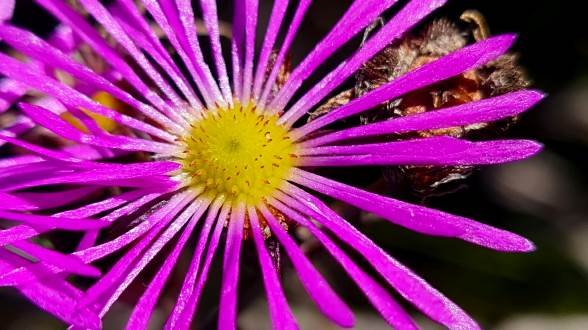
The flowers of Erepsia bracteata grow solitary from stem tips, including from short side-branchlets that allow them to form groups. Each flower has a spreading ring of narrow, magenta petals with some shine and sometimes a little white near the base. The petals widen slightly to tips that are unevenly and variably rounded to pointed. The flower centres are dominated by yellow staminodes, i.e. antherless, sterile stamens under which the proper stamens and the female styles are concealed.
The generic name, Erepsia, derived from the Greek word erepto or erepho meaning roofed over or crowned, refers to the staminode cover of the reproductive floral parts, a feature of the Erepsia genus.
Leaf-like bracts grow below the sepals. The species epithet, bracteata, refers to conspicuous bracts subtending the flowers.
Monkey beetles dig through the staminode coverings on Erepsia flowers in search of food, collecting and losing pollen grains as they go. Details of dutiful courier agents seldom matter to their clients; the colour of the postman’s eyes (almost) invariably go unnoticed. These flowers remain open at night, being one of the altydvygies (all the time mesembs). Whether monkey beetles do business of any kind at night apart from sleeping is unknown.
Flowering happens from midsummer to midautumn. The photo was taken at the end of February.
The fruit is 6 mm to 8 mm in diameter, comprising five locules (Privett and Lutzeyer, 2010; Herre, 1971; iNaturalist; https://www.worldfloraonline.org).