
Romulea rosea
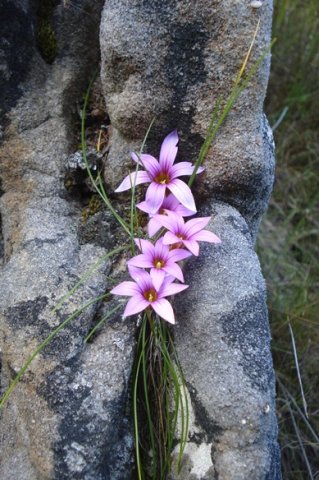
Author: Ivan Lätti
Photographer: Judd Kirkel Welwitch
Romulea rosea is sometimes commonly called onion grass or the rosy sandcrocus and locally froetang (a name derived from the Portuguese word fruta meaning fruit, maybe modified via Cape Malay), or in Afrikaans the knikkertjie (little nodder, if there could be such a thing). The young fruit capsules are edible, favoured by children and baboons.
This strong growing plant is a variable, cormous perennial reaching 10 cm to 50 cm annually when in flower. The taller plants won’t be found in spots as rocky as here on a mountain near Tulbagh. The corm is rounded with teeth on one side. The plant grows about three to six long, narrow leaves from the base. The leaves curve, their tips pointed. The leaves are 0,5 mm to 2,5 mm in diameter.
The species distribution ranges from the Kamiesberg in the Northern Cape southward across Namaqualand into the west of the Western Cape, and eastwards coastally to the west of the Eastern Cape, as far as Gqeberha.
The habitat is sandy and clayey fynbos and renosterveld slopes and flats. The habitat population is deemed of least concern early in the twenty first century.
R. rosea has escaped and became naturalised on at least three continents, viz. North America, Europe and Australia. It is regarded as a weed, at least in Australia (Curtis-Scott, et al, 2020; Vlok and Schutte-Vlok, 2015; Manning, 2007; iNaturalist; Wikipedia; https://www.fernkloof.org.za; http://redlist.sanbi.org).