
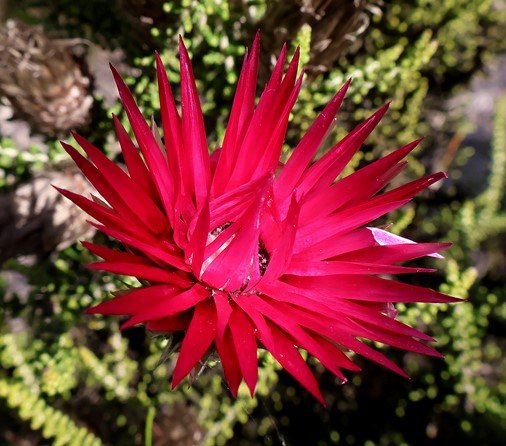
Phaenocoma prolifera young flowerhead
Author: Ivan Lätti
Photographer: MC Botha
The Phaenocoma prolifera bracts around the flowerheads are the most floral feature of the plant by far, from the human admirer’s point of view. Pollinators must also benefit from bright colouring for spotting their next meal. But it’s the tiny, inconspicuous florets, still shielded inside by the deep purple-pink bracts here that ensure the future of the plant species, while pleasing the pollinators.
The generic name of the monotypic genus, Phaenocoma, is derived from the Greek words phaino meaning to bring to light or to show and kome meaning the hair of the head, referring to the bract appearance. This is a misnomer as far as these developed bracts are concerned: they are not hairy. The new stems are, however, silvery white with hairs and terminal bristles, initially also present on the bracts (Vlok and Schutte-Vlok, 2015; Manning, 2007; Bean and Johns, 2005; Andrew, 2017; iNaturalist).