|
Botanical name |
Euphorbia excelsa |
|
Other names |
Olifants River euphorbia; olifantsriviernaboom (Afrikaans) |
|
Family |
Euphorbiaceae |
|
Dimensions |
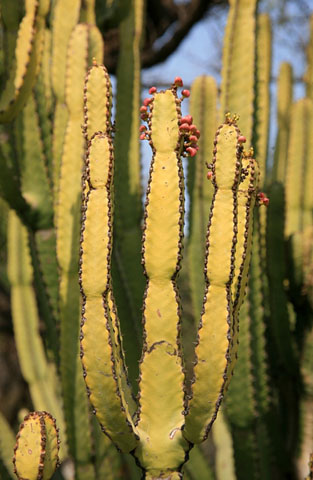
A spiny, succulent tree of occasionally up to 10 m in height with a compact rounded crown of stem tips |
|
Description of stem |
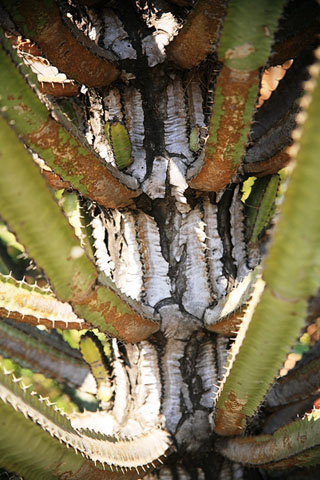
Vertical ridges occur on the single erect stem, indicating where the branches had fallen; whitish bark longitudinally fissured on the main stem among the young stem branches; the young stems are quadrangular, curving up in a regular candelabrum fashion, yellow-green to blue-green, smooth surfaces with sharp spines on the four ridges; they emerge in a whorl or regular ring at regular intervals along the stem; they are narrowed at regular intervals corresponding with the growth season length added |
|
Description of leaves |
Absent as the rudimentary leaves fall early |
|
Description of flowers |
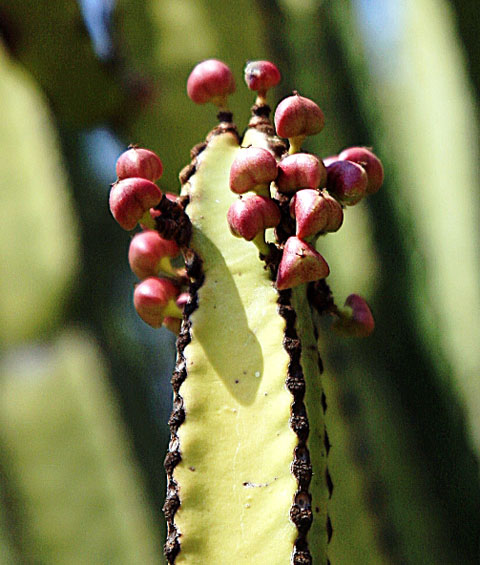
Greenish-yellow occurring in summer into autumn; the four bracts on the cyme stalk are distinctive of this species as the other tree euphorbia species have only two |
|
Desciption of seed/fruit |
Three-lobed capsule from the end of summer and in autumn |
|
Description of roots |
|
|
Variation |
|
|
Propagation and cultivation |
|
|
Tolerances |
Drought resistant |
|
Uses |
Occasional garden plant |
|
Ecological rarity |
Not threatened in its habitat, although only occurring in a limited area |
|
Pests and diseases |
|
|
Other |
|
|
Location |
Dry rocky slopes in summer rainfall areas |
|
Distribution (SA provinces) |
Limpopo |
|
Country |
South Africa |