

Gladiolus woodii
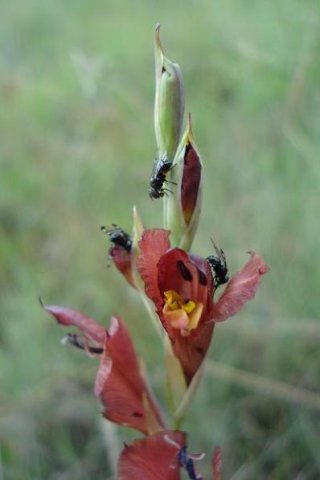
Author: Ivan Lätti
Photographer: Judd Kirkel Welwitch
Gladiolus woodii, sometimes commonly called the sheath gladiolus, and known locally by its Swazi name of sidvwana, grows an annual flower spike to 60 cm tall from a perennial corm of 1,5 cm to 3 cm in diameter. This perennial, underground storage part is covered in layers of brown, fibrous tunic to its neck.
The plant grows from one to four annual leaves. One of them emerges from the base, often sheathing the stem along all its length, alternately ending in a short, free, sword-shaped blade. This leaf is about 60 cm long and 8 mm wide. The smaller stem leaves, also sheathing conspicuously, are around 26 cm long. The hairy leaves have thickened midribs and margins. The leaves appear after flowering.
Given the unidentified visitors on the flowers in picture, the pollination of the species is believed to be done by fast-flying, ground-nesting long-tongued anthophorid bees.
The plant is found in the north-east of South Africa, in KwaZulu-Natal, the far east of the Free State, Mpumalanga, Gauteng and Limpopo, as well as Eswatini.
The habitat is grassland on rocky hillsides at elevations between 800 m and 2000 m. This is a notable flower of the Drakensberg. The habitat population is deemed of least concern early in the twenty first century.
Some of today's popular garden hybrids have this plant as an ancestor (Goldblatt and Manning, 1998; Pooley, 1998; Trauseld, 1969; iNaturalist; http://redlist.sanbi.org).