
Albums
Wooleya farinosa thriving where many can't
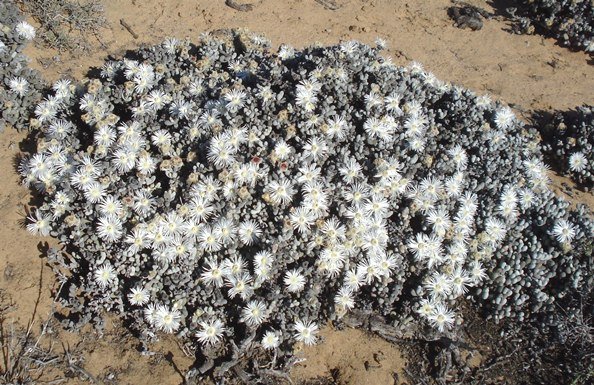
Author: Ivan Lätti
Photographer: Judd Kirkel Welwitch
Wooleya farinosa is one of those mesembs made for living in a tough world. Like all of us, it did not choose before birth to live in this place, or any particular place. Or to live in this way, or in this plant body for that matter. But it finds itself domiciled where its ancestors struggled to remain alive above all else, to such an extent that they grew all the parts required, and the resolve to continue.
Every requirement for coping with life in this place, the way to go, revealed itself in changing instalments over time. The genes in the surviving subset of all of the living plants determined the nature of the extant species. And some survived through all that was hard in the past, that’s why this one is here. Proof of success by flowering today means living within the restrictions imposed by environment, as well as possessing the qualities embedded in the ancestral genes, as changed over time in response to conditions via continued selectivity.
This is to human thinking more than reproduction, more than procreative. It is creative. The crafting of a species by hard hammering over the aeons is a remarkable form of the art of the possible. In human hands art is but one form of the beauty phenomenon, although humanity gave it a name. Nature has been at it all the time. That's why it is so beautiful. The only reason one can’t attend the full event of the becoming of a plant species as in an arts festival, is the duration of the process. Although summarising and fast forward are continually improved, aided by AI, the idea of the time taken for all this in untold generations is mind-boggling to our late-comer minds.
Evolution holds death as a paintbrush. Better adapted generations from continual discarding of what won’t work is achieved by untold early deaths of all the unsuitables before they can produce offspring. This purifies the residue, making up later generations of the adequately adapted, coming through the storms of millions of days. And this process is still ongoing for all the living, including the members of the tribe that read this.
Humanity, boosted by its successes since the Renaissance and the Industrial Revolution, may overestimate its chances against the dictates of nature. But science and technology can’t ever have the measure of the earth's challenges in the long run, the change cycles still in store for all that live here. Individual dying is small compared to species extinctions. Nature and its subset, life, are the great ones, science the follower, the student (Cowling and Pierce, 1999; Smith, et al, 1998; iNaturalist; Wikipedia).