
Albums
Rumohra adiantiformis
Author: Ivan Lätti
Photographer: Thabo Maphisa
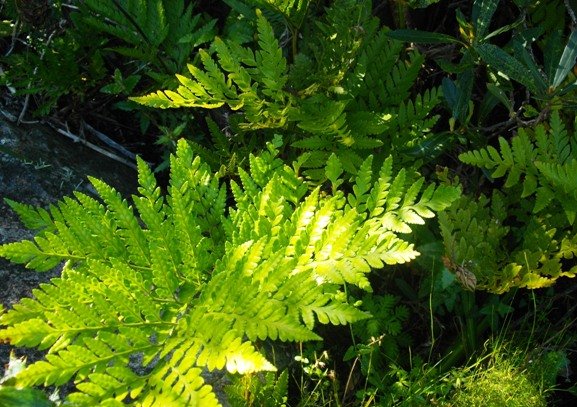
Rumohra adiantiformis, commonly the seven weeks fern, the leatherleaf fern or the Knysna fern, is a sturdy, spreading fern growing fronds from 25 cm to 1 m long. The evergreen plant grows from a creeping, rusty-red and scaly rhizome, the fronds arising singly. The species forms part of the Dryopteridaceae family. The genus comprises five species, only the most widespread one occurring in South Africa.
The sori or reproductive clusters of spores of this plant appear on the underside of pinnae (leaflets) on all the fronds, not only on specialised reproductive fronds, as in the case of many other ferns. The sori are circular, about 2 mm in diameter.
The species distribution is widespread in Europe, Africa, South America and Australia, mainly in the Southern Hemisphere. In South Africa the plant grows along the south and east coasts of the Western Cape, the Eastern Cape and KwaZulu-Natal, as well as inland in parts of Mpumalanga and Limpopo.
The habitat is moist forest floors, the plants sometimes sheltered by boulders near water. The habitat population is deemed of least concern early in the twenty first century.
This is a sought-after species among florists and gardeners valuing the long-living, deep green fronds that do not wilt soon. It is a hardy plant that succeeds in shade or semi-shade spots of well-watered gardens, also in hanging baskets (Bean and Johns, 2005; iNaturalist; Wikipedia; www.plantzafrica.com; http://redlist.sanbi.org).