
Albums
Virgilia oroboides
Author: Ivan Lätti
Photographer: Francelle van Zyl
Virgilia oroboides, the keurboom or brown-haired keurboom is a small to medium-sized, evergreen (seldom deciduous) tree with rounded or conical crown shape and bushy growth habit. It reaches heights from 5 m to 15 m (SA Tree List No. 221). The bark is pale grey brown and smooth, later darker and slightly fissured. Hair colour on young branchlets distinguish the two subspecies, rusty red on subsp. ferruginea, white on subsp. oroboides. The trees may branch close to the ground.
The keurboom is fast-growing when young but relatively short-lived, often becoming only between twelve and twenty years old.
The alternate, imparipinnate leaves (compound with a terminal leaflet), have six to twelve leaflet pairs, the stipules dropping off early. The leaflets are narrowly oblong, broadly tapering at the tips with hair-like protrusions, and broadly tapering or rounded at the bases with margins entire. The leaflet blades are glossy green above and have brown or velvety hairs below. Leaflet dimensions are 13 mm to 25 mm long and 6 mm to 8 mm wide.
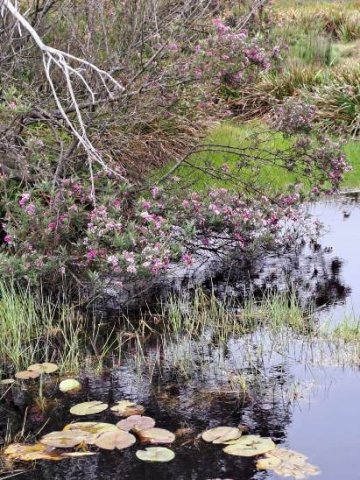
The sweet-scented, pea-shaped flowers are pink in various shades to violet, growing in sprays of about 10 cm long at stem-tips. Bloomtime is a profuse flowering affair in the earlier part of summer or later in autumn. The specific name, oroboides, is derived from Orobus, an old genus name of sweet pea type plants growing similar flowers.
The fruit is a flat, hairy pod, brown when ripe. Pod dimensions are about 8 cm long and a little wider than 1 cm.
The species distribution is coastal in the Western Cape from the Cape Peninsula to around George.
The habitat is streambanks and forest margins, the tree often a pioneer. Both subspecies have habitat populations considered of least concern early in the twenty first century.
The tree is often planted in gardens, V. divaricata being more popular (Venter, 2012; Coates Palgrave, 2002; Rycroft 1980; iNaturalist; http://redlist.sanbi.org).