
Albums
Tecomaria capensis
Author: Ivan Lätti
Photographer: Thabo Maphisa
Tecomaria capensis, commonly called the Cape honeysuckle, in Afrikaans the Kaapse kanferfoelie (Cape honeysuckle) or trompetters (trumpeters), and previously scientifically Tecoma capensis, is almost always a scrambling shrub, rarely a small tree (SA Tree List No. 673.1).
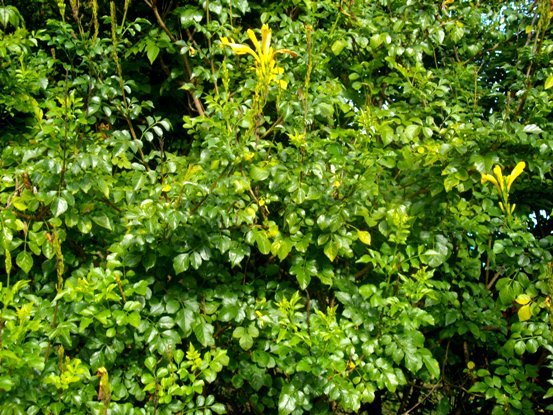
The species distribution is along the South African south and east coasts, from the southern Cape in the east of the Western Cape, the Eastern Cape, KwaZulu-Natal, and inland in Mpumalanga and Limpopo. as well as in eSwatini, Mozambique, and further. The capensis specific adjective stems from the first description of the plant. This yellow flowering form of the plant was seen in a Gauteng garden.
The habitat is forest margins and thickets. The habitat population is deemed of least concern early in the twenty first century. The species was found to escape and slightly invade bushveld in the Magaliesberg. Foliage is as dense and lush as seen here unless the plant suffers drought stress.
There is another genus called Tecoma comprising South American plants, and represented in South Africa by one of the exotics as an escape. Tecomaria capensis was once classified as a Tecoma but no longer. There are other Tecomaria species in Africa, only this one in South Africa (Coates Palgrave, 2002; Pooley, 1998; Riley, 1963; Letty, 1962; iNaturalist; http://redlist.sanbi.org).