

Leobordea pulchra
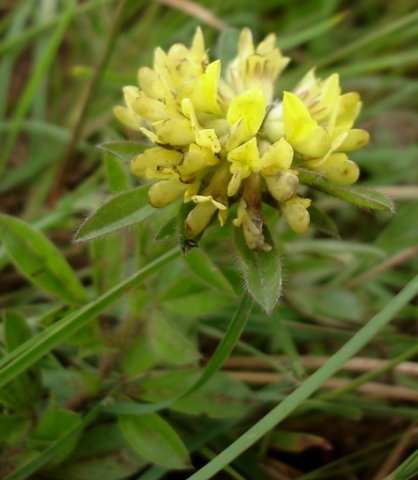
Author: Ivan Lätti
Photographer: Judd Kirkel Welwitch
Leobordea pulchra, previously known scientifically as Lotononis pulchra, is a semi-prostrate, resprouting perennial growing annual, ascending stems to heights around 28 cm from a woody rootstock. The stems may initially be angular, later cylindrical, slightly hairy, ochre coloured and often densely leafy.
The trifoliolate leaves grow on petioles of about 5 mm but the leaflets have no petiolules. The leaflet shape is lanceolate to oblong or oblanceolate, the central one slightly longer. The leaflet upper surfaces are nearly hairless, the lower ones sparsely hairy, the blades leathery and folded in laterally along the centre. A single, hairy stipule is present at the petiole base of each leaf. Leaflets are up to 18 mm long and 6 mm wide.
The flowers grow at stem-tips in dense, hemispherical, corymb-like clusters of about 3,5 cm in diameter. Sometimes smaller, fewer-flowered clusters grow on upper stems from leaf axils. The pedicels are about 1 cm long, slightly hairy with linear bracteoles on them. The sepals are triangular and hairy. The lemon-yellow, hairless flowers in peaflower shape are often suffused pink. The standard petal is clawed, the wings sickle-shaped and the keel boat-shaped. Flower diameter is about 1 cm. Flowering happens from early summer until after midsummer.
The specific name, pulchra, is a Latin word meaning beautiful, referring to the inflorescences.
The species distribution is in the Eastern Cape, KwaZulu-Natal and Mpumalanga, as well as some neighbouring countries. The photo was taken near the Sani Pass.
The habitat is rocky grassland to elevations around 1800 m. The habitat population is deemed of least concern early in the twenty first century (Pooley, 1998; iNaturalist; https://www.worldfloraonline.org; http://redlist.sanbi.org).