

Helichrysum cochleariforme
Author: Ivan Lätti
Photographer: Judd Kirkel Welwitch
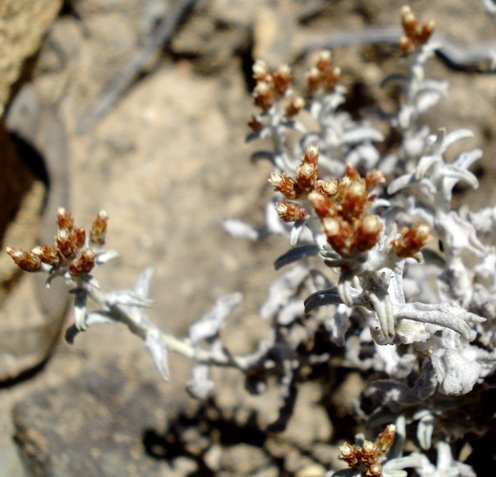
Helichrysum cochleariforme, commonly known as gold-and-silver and in Afrikaans as duineteebossie (little dune tea bush), is a low, rounded shrublet growing to heights from 10 cm to 40 cm. The stems and leaves are grey-woolly to greenish grey.
The alternate, simple, narrow leaves broaden to their tips in spoon-shapes and fold in along on the sides.
The few, small, globular flowerheads have rows of golden-brown involucral bracts, the inner ring white at the tips around the yellow disc florets. Flowering happens in spring to early summer.
The specific name, cochleariforme, is derived from the Greek word cochlea meaning a snail shell and the Latin word forma meaning form or shape, referring to the shape of the concave involucral bracts around the flowerheads.
The distribution is in the Western Cape, partly on the west coast from Piketberg to Darling and along the south coast from Bredasdorp to Mossel Bay in two discrete areas. This plant was photographed near Riebeek West.
The habitat is coastal scrub on dunes and flats in sandy soils. The habitat population is deemed near threatened early in the twenty first century, due to coastal development and invasive alien trees (Manning, 2007; Bond and Goldblatt, 1984; Andrew, 2012; iNaturalist; iSpot; http://redlist.sanbi.org).