
Albums
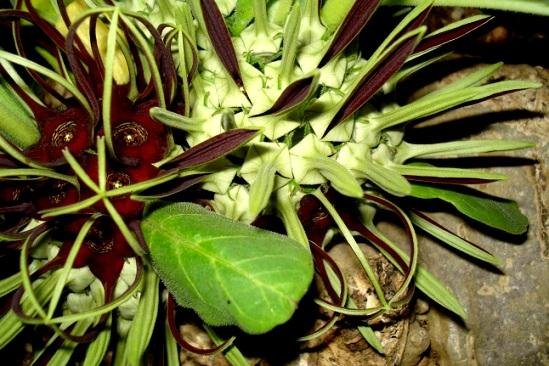
Brachystelma barberae leaf
Author: Ivan Lätti
Photographer: Judd Kirkel Welwitch
Brachystelma barberae has been described as the most spectacular member of its genus and the most well-known caudiciform member of the family. This allure has attracted botanical artists for a long time. The first known instance happened as far back as 1866 when the plant was painted by Mrs Mary Elizabeth Barber, whose brother, a Mr Bowker, collected the specimen for her in the Eastern Cape. Aloe barberae, now known as Aloidendron barberae was also named after her.
The broad, oblong, flat-tipped leaf in picture with its fine, whitish hairy covering has a yellowish midrib and irregularly alternating lateral veins that ascend at similar angles in fish-bone style.
The fruits of B. barberae grow in pairs of long cylindrical follicles that taper at both ends, more so to their tips. The second follicle in the pair growing from each flower often does not develop. Many seeds are released from each follicle. Each seed is fitted with a hairy appendage that facilitates wind dispersal.
The Brachystelma genus is closely related to another genus of the Apocynaceae family, viz. Ceropegia (Germishuizen and Fabian, 1982; Letty, 1962; iNaturalist; www.plantzafrica.com).