
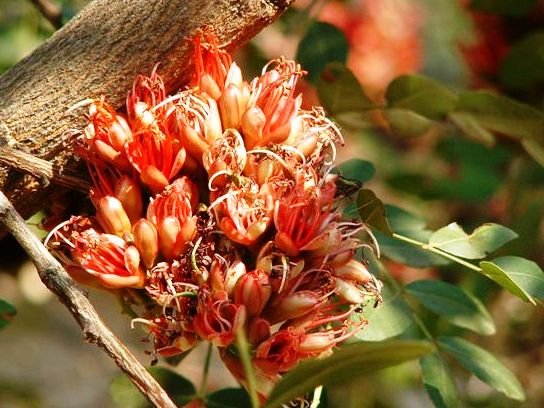
Schotia brachypetala old flowers
Author: Ivan Lätti
Photographer: Ricky Mauer
Schotia brachypetala produces dense masses of red flowers in late winter to spring, making the weeping boerbean a commanding and memorable presence in the lives of those having the privilege of spending some discretionary time near them. It is the abundance of nectar dripping from the flowers that brought the tree the weeping part of the weeping boerbean common name. The broad, flat, woody fruit pods did the rest.
Winter deciduous during some years, the still bare tree may grow a profusion of flower sprays before the leaves arrive. In other years leaves and flowers arrive simultaneously, while some trees are evergreen, given suitable conditions.
Flowers grow on old wood, rarely at stem-tips. The clusters are 6 cm to 13 cm in diameter. The deep red or scarlet, branched heads or panicles have no petals or narrow ones, 1,5 cm long. It is the showy sepals and far exserted stamens joined at the base that steal the blooming show (Coates Palgrave, 2002; Schmidt, et al, 2002; Pooley, 1993; iNaturalist).