
Albums
Polygala bracteolata
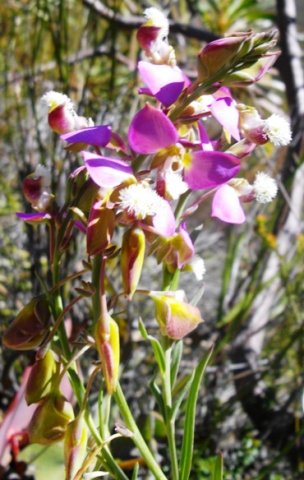
Author: Ivan Lätti
Photographer: Thabo Maphisa
Polygala bracteolata, sometimes called the lanceleaf butterflybush or the butterfly falsepea, has an erect or spreading, slightly hairy growth form. It achieves heights from 20 cm to 80 cm, branching from the base. The name spear-leaved milkwort for this species was recorded as long ago as 1796 in an edition of the Botanical Magazine (London).
The species distribution ranges from the southwestern extreme of the Northern Cape, through Vanrhynsdorp, the Gifberg, Robertson and Hermanus in the Western Cape to Humansdorp in the Eastern Cape.
The habitat is fynbos flats and lower slopes, from the coast to elevations around 900 m. The habitat population is deemed of least concern early in the twenty first century.
Kubitzki and others (2004) report an instance in The Families and Genera of Vascular Plants that the period of seed dormancy for P. bracteolata is known on one occasion to have exceeded 42 years.
There is an orchid, Disperis capensis that resembles P. bracteolata to such an extent that the orchid is also pollinated by the Polygala pollinator! Plant law, unlike its human counterpart, is not compulsively litigious. Plant competitiveness for resources and space is fierce, but without fights or grudges, resembling the coopetition to which human businesses sometimes aspire, if competition authorities don't scare them (Marais, (Ed.), 2017; Bean and Johns, 2005; Bond and Goldblatt, 1984; iNaturalist; Wikipedia; www.plantzafrica.com; http://redlist.sanbi.org).