
Albums
Agapanthus
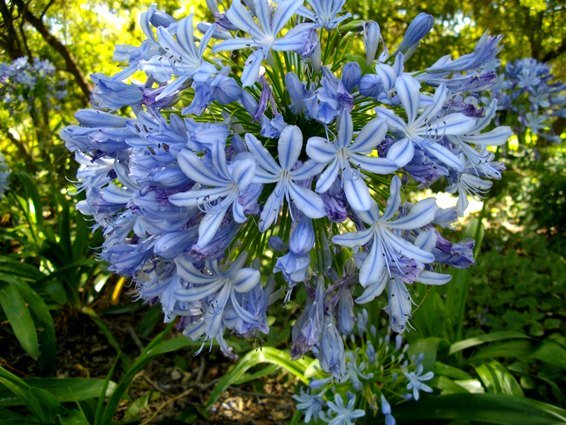
Author: Ivan Lätti
Photographer: Thabo Maphisa
Agapanthus is a genus of monocot perennials that form clumps, growing from cylindrical, branched rhizomes developing many fleshy roots. Numerous strap-shaped leaves are distichous from the base, sometimes in clear to see, multiple fan-shapes.
Umbels of many stalked, bisexual, blue or white flowers grow on long, leafless peduncles well above the leaves. The short-tubed flowers spread their tepals in cylindrical to bell-shaped or funnel-shaped corollas. The tepals of each flower grow in two concentric whorls of three each.
There are six stamens of two types arising from a perianth tube, arching up at their tips. The superior ovary is oblong to ovoid, consisting of three locules in which many ovules grow from the central axis.
The capsule is ovoid or spindle-shaped, opening per locule when ripe. The winged, black seeds are flat, ovate and shiny.
There are about ten species of Agapanthus, all occurring in southern Africa, and three in the fynbos. The plants are often associated with montane grassland at higher elevations. Several of them are endemic to South Africa, but some are renowned world travellers, occurring in many gardens and nurseries. Many popular cultivars, some presenting unusual flower colours have been produced in horticulture, mainly derived from Agapanthus praecox of the South African southeastern coast.
The photo was taken in the Walter Sisulu National Botanical Garden during January (Leistner, (Ed.), 2000; Manning, 2009).