
Albums
Euphorbia pentagona
Author: Ivan Lätti
Photographer: Ivan Lätti
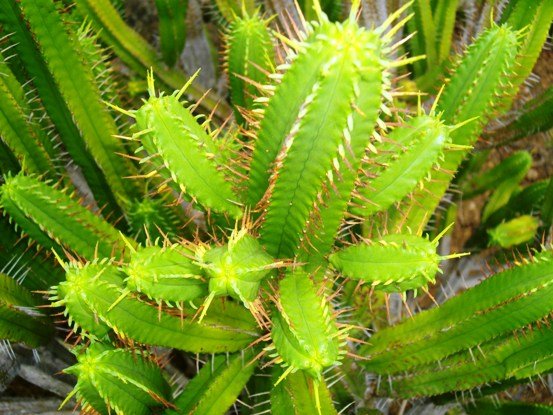
Euphorbia pentagona, commonly known in Afrikaans as the noorsdoring (spurge thorn), is a stem succulent reaching heights around 2 m. It is a much-branched shrub growing erect, finger-like stems. The plants are often wider than they are tall. Old plants may develop tree-like lower trunks. The latex exuded by damaged plant parts may be poisonous.
E. pentagona resembles E. enopla, which is often smaller and more branched, now part of E. heptagona. E. pentagona also used to be called E. heptagona in the past. Since that name is still in existence for another recognised species, there may still be confusion relating to plant names in this related group or complex.
The upper stems of E. pentagona are light green when young, the spines on the stem ridges yellowish to lemon coloured. The lower, older parts grow darker until they are pale grey. The stems are five-edged, winged or ribbed, or a number close to that, occasionally up to nine-ribbed. These spines are really the remaining, bare peduncles where the cyathia, or after them the fruit capsules have dropped off. The smooth stem surfaces between the ridges are slightly concave and undulating. The short-lived leaves on new stem-tip growth are about 4 mm long.
The cyathia of E. pentagona grow solitary or in cymes of up to three at stem-tips on short peduncles that often persist as spines. The false flowers are purple, lavender, buff or yellow-green. The bracts spread, and there are elliptic, dark nectar glands. Cyathium diameter is about 4 mm.
The fruit is a nearly spherical dehiscent capsule on a short pedicel. Capsule diameter is about 6 mm.
The species distribution is in the Eastern Cape from east of Uniondale to near Makhanda (Grahamstown).
The habitat is comparatively dry scrub and thicket. The habitat population is deemed of least concern early in the twenty first century.
E. pentagona is planted by traditional populations as hedges, the plant also seen in gardens. The dry branches are said to be used as fuel for fires, presumably more for heat than cooking. Fumes from dried branches containing Euphorbia latex may exude irritant compounds that could settle on food, and cause gastrointestinal irritation, maybe not as toxic as tamboti branches but worth avoiding. Exposure to the smoke might inflame airways (Frandsen, 2017; iNaturalist; Wikipedia; www.cactus-art.biz; https://www.llifle.com; http://redlist.sanbi.org).